Ice Rink Maintenance Equipment
Ice Resurfacer Blades
Premium replacement ice resurfacer blades engineered for professional ice rinks and arenas. The Blue Blade is a stainless-steel ice rink blade that lasts longer, stays sharper, and cuts smoother ice than a standard carbon-steel blade — available in 77-inch and 84-inch sizes to fit full-size ice resurfacing machines.
Double
Lifespan
Up to $7,751
Savings / 2 Years
3× Lower
Cost / Cutting Hour
3–4× Fewer
Sharpening Trips
Figures are per resurfacing machine over two years with local sharpening, compared with a standard carbon-steel blade. Remote rinks that ship blades out for sharpening save even more. See each size for full specifications.
Choose Your Blade Size
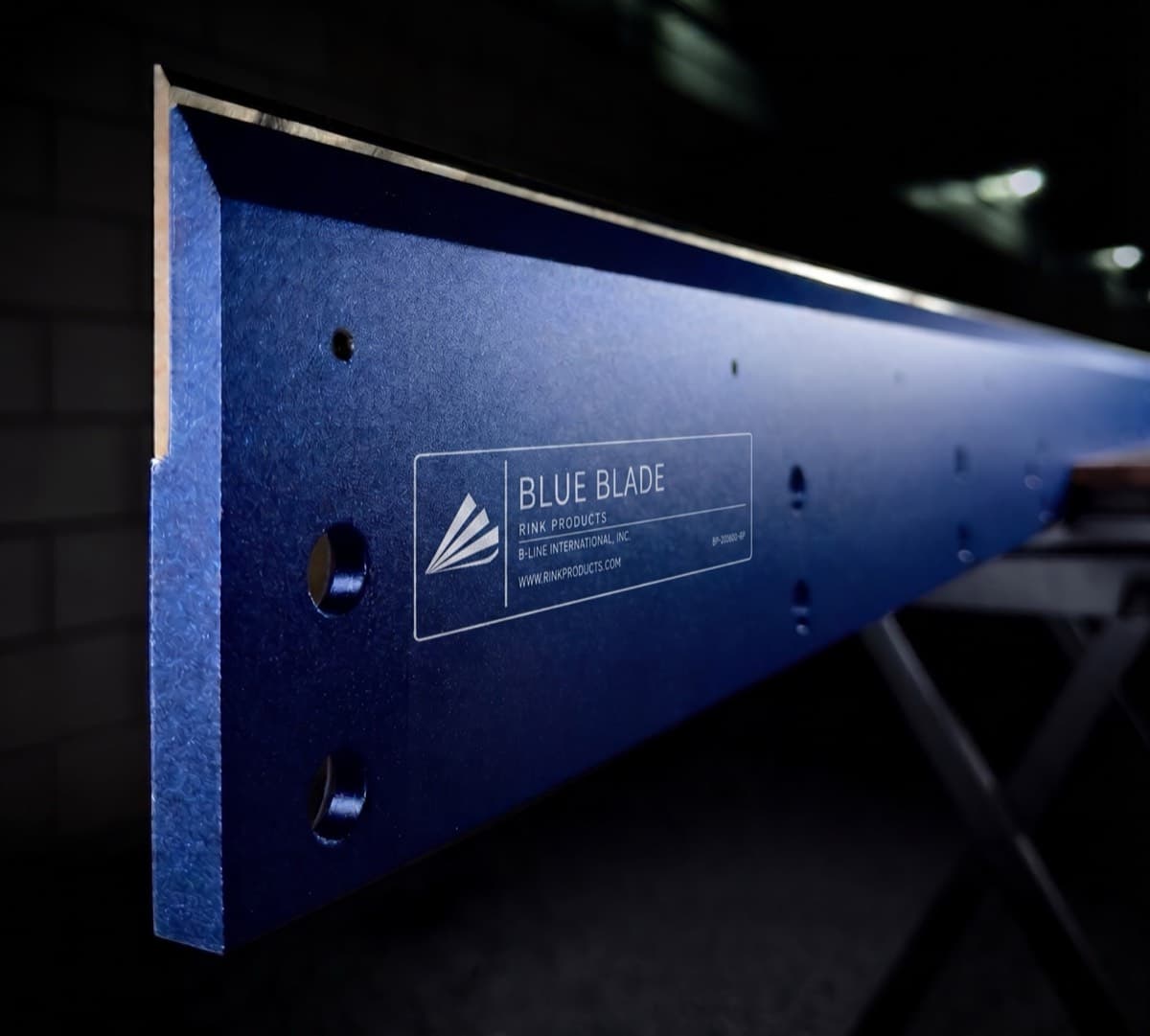
77" Ice Resurfacer Blade
23 lb · fits most full-size, single-blade ice resurfacers.
$695.00
84" Ice Resurfacer Blade
25 lb · fits larger ice resurfacing machines that take an 84-inch blade.
$745.00
Why Upgrade From a Standard Blade
Double the lifespan
Rust-resistant stainless steel holds its edge far longer, so the Blue Blade lasts at least twice as long as a standard carbon-steel blade. Exact lifespan depends on how often you cut and your water hardness.
Sharpened at least 3–4× less often
Rinks running the Blue Blade report six to eight weeks between sharpenings, or three to four weeks where the operator pulls it early, against about weekly for a standard blade. In our two-year cost model that is up to 156 fewer trips to the sharpening house, with less downtime and fewer spare blades tied up.
58–62% lighter
23–25 lb versus a typical 55–65 lb standard blade, with threaded points on the blade body for lifting handles, so every blade change is less than half the lift.
Smoother ice, less drag
A truer, sharper edge shaves cleaner ice and puts less load on the resurfacer, which customers feel as better ice and operators see as less machine wear.
About Ice Rink Blades
Every sheet of ice an arena lays down starts at the blade. As a resurfacer makes its passes, the ice rink blade shaves off the scored top layer so a thin film of fresh water can freeze into a clean surface. A dull or rusted blade leaves ridges, chatter, and snow — and forces the machine to work harder.
That is why the blade is the single most important wear part in ice resurfacing. The Blue Blade was built to change the economics of that wear part: a stainless-steel edge that resists rust between uses, holds its sharpness at least three to four times longer than standard carbon steel, and weighs 58–62% less, so every blade change is less than half the lift. Browse the 77-inch and 84-inch sizes above, or explore the rest of our ice arena products.
Maintenance Guides
How Often to Sharpen an Ice Resurfacer Blade
The real interval, why the calendar is the wrong unit to measure it in, and what moves the number from one rink to the next.
Diagnosing Bad Ice: Chatter, Ridges and Snow
A symptom-by-symptom read on what the ice is telling you, and how to tell a blade problem from a machine problem.
Stainless vs Carbon Steel Ice Resurfacer Blades
Edge retention, rust, weight, what makes a good blade, and the cost comparison that only makes sense per cutting hour.
Is a Standard Ice Resurfacer Blade Ever the Better Choice?
Why damage risk is not a case for a standard blade, what a strike does to each material, and the operating habits that prevent it.
Frequently Asked Questions
- What is an ice resurfacer blade?
- An ice resurfacer blade is the long steel blade mounted under an ice resurfacing machine that shaves a thin layer off the ice on each pass, leaving a smooth, level sheet. It is a wear part that dulls with use and must be sharpened or replaced regularly.
- How often should an ice resurfacer blade be replaced?
- Rinks running the Blue Blade report six to eight weeks between sharpenings, or three to four weeks where the operator pulls it early, against about weekly for a standard blade. Beyond that it depends on how much the machine cuts and how abrasive the water is, so there is no single number. What stays consistent is the comparison: the Blue Blade needs sharpening at least three to four times less often than a standard carbon-steel blade, so its rust-resistant stainless edge lasts at least twice as long before it is worn down and has to be replaced.
- What size ice resurfacer blade do I need?
- Full-size single-blade resurfacers generally use a 77-inch blade, while larger machines use an 84-inch blade. The Blue Blade is available in both 77-inch and 84-inch sizes. If you are unsure, contact us with your machine make and model and we will confirm the right fit.
- Will the Blue Blade fit my Zamboni® or Olympia ice resurfacer?
- The Blue Blade is an aftermarket replacement blade sized to fit full-size ice resurfacing machines, including Zamboni® and Olympia resurfacers. Full-size single-blade machines generally take the 77-inch blade, while larger machines take the 84-inch. Contact us with your machine make and model and we will confirm the right fit before you order.
- How much can the Blue Blade save compared to a standard blade?
- Because it holds an edge at least three to four times longer, our two-year cost model puts the saving at up to $7,751 per machine — around 70% less than running a standard blade — at about a third of the cost per cutting hour, even after its higher purchase price. That figure is for a blade getting 50 cutting hours per sharpened edge; at 80 hours the saving is $4,801. Both edge lives are what customers report.
- Are these blades sharpened or thrown away?
- They are sharpened and reused, just like standard blades — the Blue Blade simply needs sharpening far less often. Its stainless construction also resists the rust that shortens the life of standard carbon-steel blades between uses.
- When is it better to use standard blades?
- Not one we'd recommend, but there is a real difference worth knowing. Hard contact with concrete, a threshold or metal frozen into the ice damages any resurfacer blade, and at that kind of force a standard blade will most likely crack too. It has a slightly better chance of denting or rolling instead, because carbon steel has a little more ductility at the same hardness — but a dent from a strike that hard is deep enough that grinding it out costs close to what a new blade does. Either way the blade is done. So the operating rules are the same for every blade and worth following on every blade: raise it before leaving the ice, look at the sheet before cutting on public-skate ice, and inspect the edge after any suspected strike.
Zamboni® is a registered trademark of Frank J. Zamboni & Co., Inc. Olympia is a trademark of Resurfice Corp. Rink Products is not affiliated with, endorsed by, or sponsored by either company.